
Tiny Whirlpools Are Swirling All Over the Sun — And We Just Saw Them for the First Time!
Quick Summary
Scientists using the world’s most powerful solar telescope have spotted tiny spinning whirlpools on the surface of the Sun. These swirling plasma spirals have never been seen before. The discovery, published this week in the journal Nature, could help us better understand solar storms.
What Happened?
High up on a mountain in Hawaii, there is a giant telescope called the Daniel K. Inouye Solar Telescope. It is the largest solar telescope on Earth. Its mirror is 4 meters wide — about as tall as a full-grown giraffe.
In April 2025, scientists pointed this powerful telescope at a busy, magnetically active patch of the Sun. When they got their pictures back, they were amazed at what they saw.
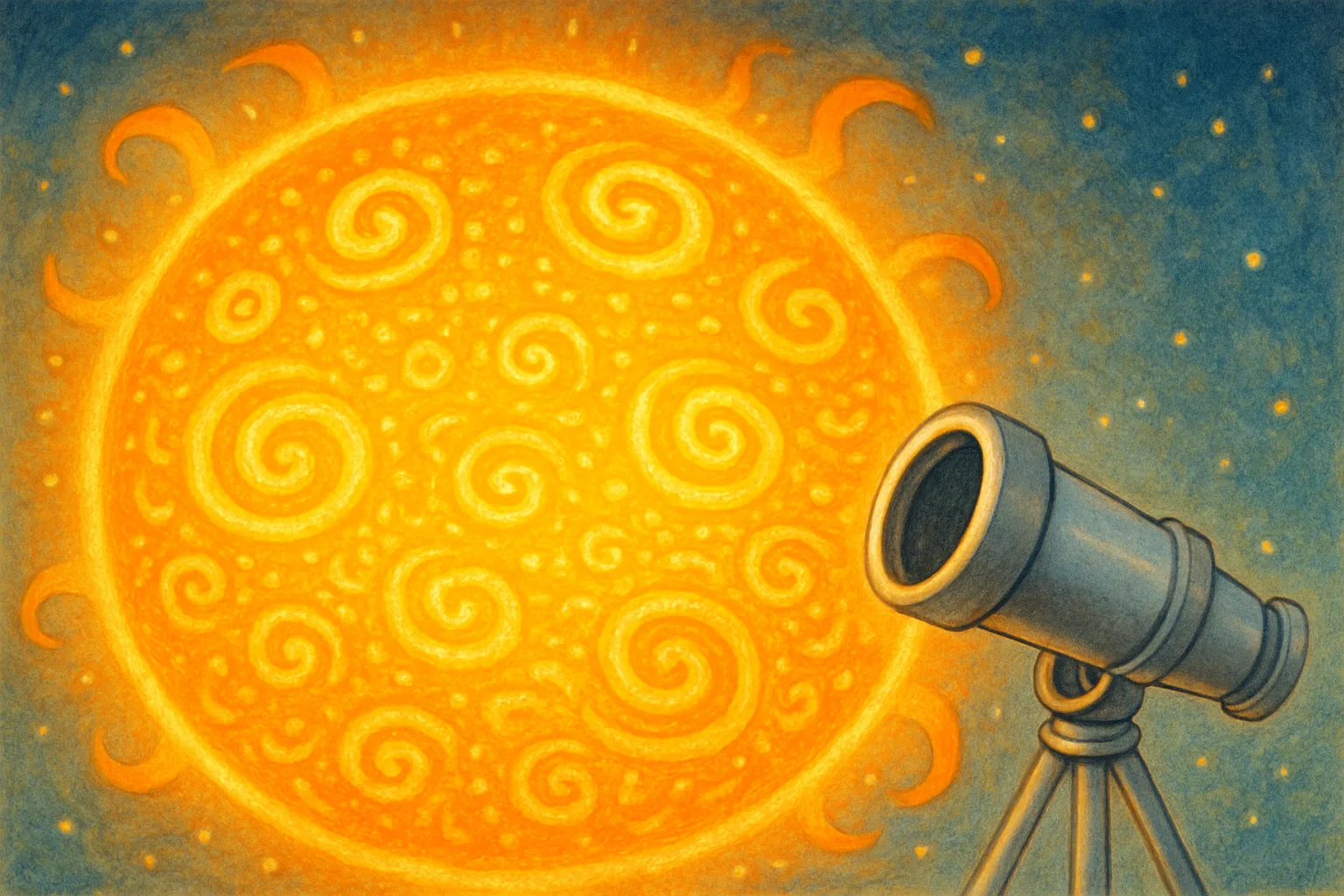
Tiny swirling whirlpools — called plasma vortices — were spinning all across the Sun’s surface. Each one was only about 20 kilometers wide. That sounds big, but compared to the Sun, it is incredibly small. If Earth were the size of a basketball, each vortex would be about the size of a single thread.
Scientists call these shapes Kelvin-Helmholtz instabilities. That is a mouthful! Think of them like tiny waves that curl up when two rivers of water moving at different speeds run next to each other. On the Sun, it is the same idea — but instead of water, it is superheated plasma, the same glowing stuff that makes the Sun shine.
These vortices form at the edges of the Sun’s magnetic regions. They twist and tangle the Sun’s magnetic field lines, like braiding hair — but much more powerful and much, much hotter.
Why Does It Matter?
Understanding these tiny whirlpools is a big deal. Scientists believe these spinning shapes are part of why the Sun shoots out solar flares and coronal mass ejections. Solar flares are giant bursts of energy. Coronal mass ejections are huge clouds of charged particles. Both can travel through space and hit Earth.
When those bursts reach our planet, they can disrupt satellites, knock out power grids, and cause colorful auroras in the sky. The better scientists understand how these bursts begin, the better they can predict space weather — just like forecasting rain before a storm.
Researchers say that spotting these tiny vortices was only possible because the Inouye telescope is so powerful. For decades, scientists suspected these whirlpools existed, but no telescope could see them. Now that they have been confirmed, a whole new window into how the Sun works has opened up.
Big Words
- Plasma — a superheated form of matter made of electrically charged particles; it is what stars like the Sun are made of
- Vortex — a spinning, whirlpool-like swirl of liquid or gas; the plural is vortices
- Solar flare — a sudden, powerful burst of energy and light from the Sun’s surface
- Coronal mass ejection — a giant cloud of charged particles blasted out from the Sun into space
- Magnetic field — an invisible force that pulls or pushes magnetic objects; the Sun has a huge and powerful one
Fun Fact
The Sun is so big that about 1.3 million Earths could fit inside it — yet these newly discovered vortices are so small, you would need the most powerful solar telescope ever built just to spot them!
Think About It
If scientists can now predict solar storms better, what kinds of things on Earth might they protect — and how would you feel knowing a solar storm was coming?
Sources
- NSO (National Solar Observatory) — NSF Inouye Solar Telescope Enables Major Discovery of a Hidden Solar Process (Aug 5, 2026)
- Sci.News — Inouye Solar Telescope Discovers Hidden Plasma Vortices on Sun (Aug 7, 2026)
- Max-Planck-Gesellschaft — Tiny Vortices Discovered on the Sun’s Surface (Aug 2026)
- phys.org — Tiny vortices discovered on the sun’s surface (Aug 5, 2026)
- ScienceAlert — Record-Breaking Images Reveal The Sun Is Teeming With Whirling Vortices (Aug 2026)