
Secret Ocean! A Moon of Uranus May Have Been Hiding a Watery World
Quick Summary
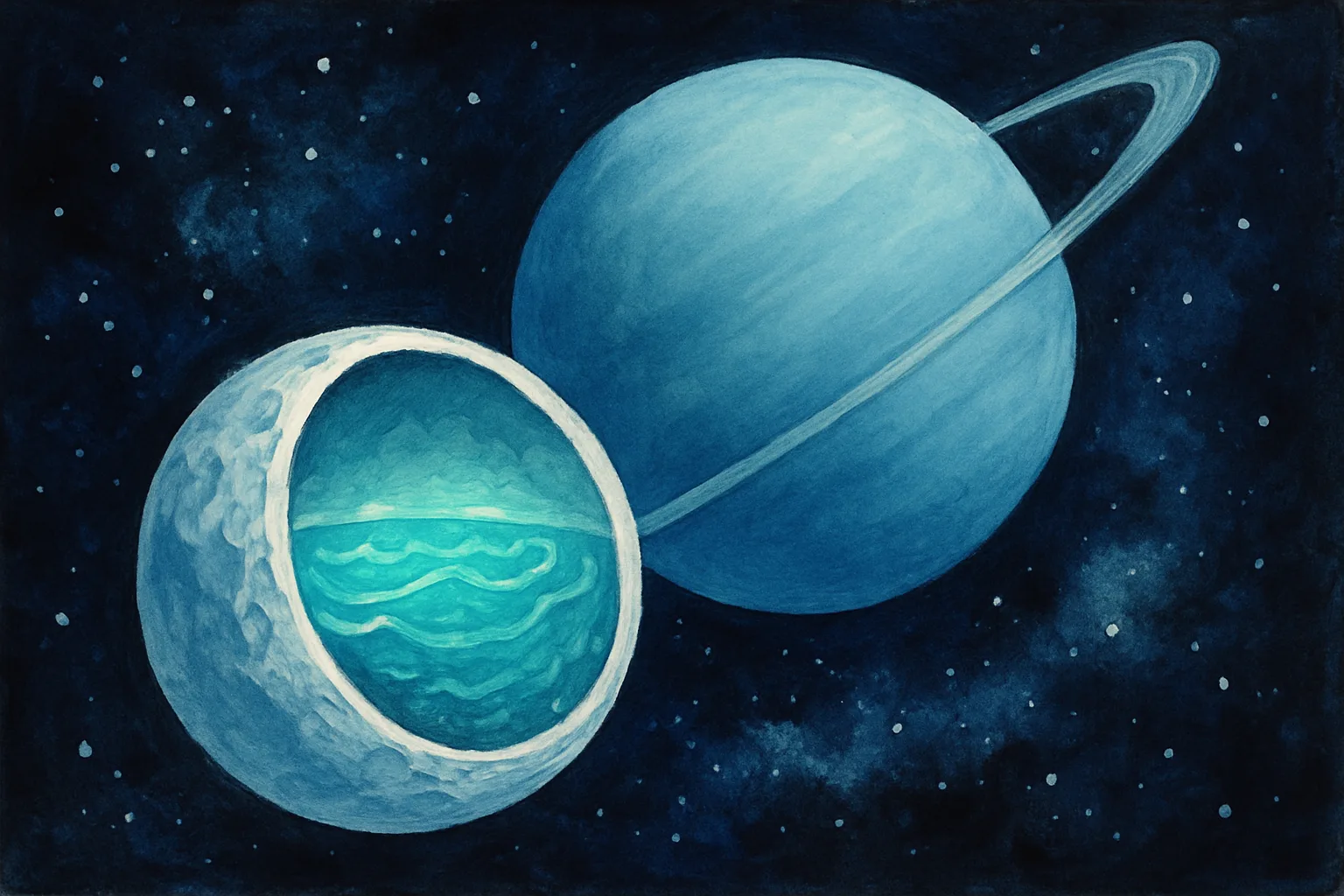
Scientists have found evidence that Ariel, one of Uranus’s moons, may have once had a huge hidden ocean beneath its frozen surface. That ocean could have been more than 100 miles deep — which is 40 times deeper than the deepest part of Earth’s oceans!
What Happened?
Uranus is the seventh planet from the Sun. It is a pale blue-green ice giant, and it has many moons. One of those moons is called Ariel. To the naked eye, Ariel would look like a tiny, frozen ball. But scientists think something spectacular may have been hiding underneath its icy shell.
New research, published in a scientific journal called Icarus, studied the surface of Ariel in detail. The moon is covered in deep canyons, long cracks, and smooth flat plains. These features were created by something — but what?
Scientists believe the answer may be water. Their models suggest that long ago, Ariel had an ocean about 100 miles (170 kilometers) deep beneath its surface. For comparison, the Pacific Ocean — the deepest on Earth — averages just about 2.5 miles deep. Ariel’s ancient hidden ocean would have been roughly 40 times deeper than that!
All that water put enormous pressure on Ariel’s icy crust. Over time, it cracked and shifted, carving out the valleys and canyons we see today. On top of that, scientists found carbon dioxide ice on Ariel’s surface in unexpected places. The most likely explanation is that gases are leaking up from the inside — possibly from a liquid ocean that may still exist today.
The only spacecraft to ever visit Uranus was NASA’s Voyager 2, which flew past in 1986. Scientists want to return. One researcher said simply: “We just need to go back to the Uranus system and see for ourselves.”
Why Does It Matter?
Every time scientists find evidence of water somewhere in the solar system, it raises an exciting question: Could life exist there? Water is one of the key ingredients for life as we know it. Ariel joins a growing list of moons — including Jupiter’s Europa and Saturn’s Enceladus — that might have liquid water hiding beneath their frozen surfaces.
Big Words
- Subsurface ocean — an ocean hidden below the surface of a moon or planet, beneath a layer of ice or rock
- Crust — the hard outer layer of a planet or moon, like the shell of an egg around the egg white inside
- Carbon dioxide — a gas found in Earth’s air and the fizzy bubbles in soda; in cold, distant space it can freeze into ice
- Ice giant — a planet made mostly of icy materials such as water, ammonia, and methane; Uranus and Neptune are the solar system’s two ice giants
- Icarus — a scientific journal where researchers publish studies about planets, moons, and other objects in the solar system
Fun Fact
Ariel has the brightest surface of all of Uranus’s large moons! Scientists think that is partly because material from inside — possibly from that ancient ocean — has been slowly resurfacing it over billions of years, covering up old, darker craters with fresher, brighter material.
Think About It
If you could design a spacecraft to explore Ariel’s hidden ocean, what would be the most important tool you would bring along, and why?
Sources
- ScienceDaily — ‘We just need to go back’ — Uranus’ moon Ariel may have hidden a 100-mile-deep ocean (Sept. 24, 2026)
- Planetary Science Institute — Evidence of a past, deep ocean on Uranian moon Ariel
- Earth.com — Another moon in our solar system may have a deep hidden ocean
- EarthSky — Does Uranus’ moon Ariel have a hidden ocean?