
Scientists Just Gave a Defeated Medicine Its Superpowers Back!
Quick Summary
Some dangerous bacteria have learned to defeat one of our most important medicines. But scientists just found a clever way to fix that. By giving the medicine a tiny helper, they made it work again.
What Happened?
Imagine you have a special key that opens a very important lock. Now imagine the lock slowly changes shape so your key doesn’t fit anymore. That’s exactly what has been happening with a powerful medicine called vancomycin.
Vancomycin is one of the strongest antibiotics doctors have. An antibiotic is a medicine that kills dangerous bacteria — the tiny germs that can make you very sick. Doctors use vancomycin as a last resort against really tough infections, including ones caused by bacteria called MRSA and C. diff. These bacteria can spread through hospitals and make very ill people even sicker.
But some of these bacteria have evolved — they slowly changed over many years — so that vancomycin could no longer kill them. Scientists call these tough survivors “superbugs.”
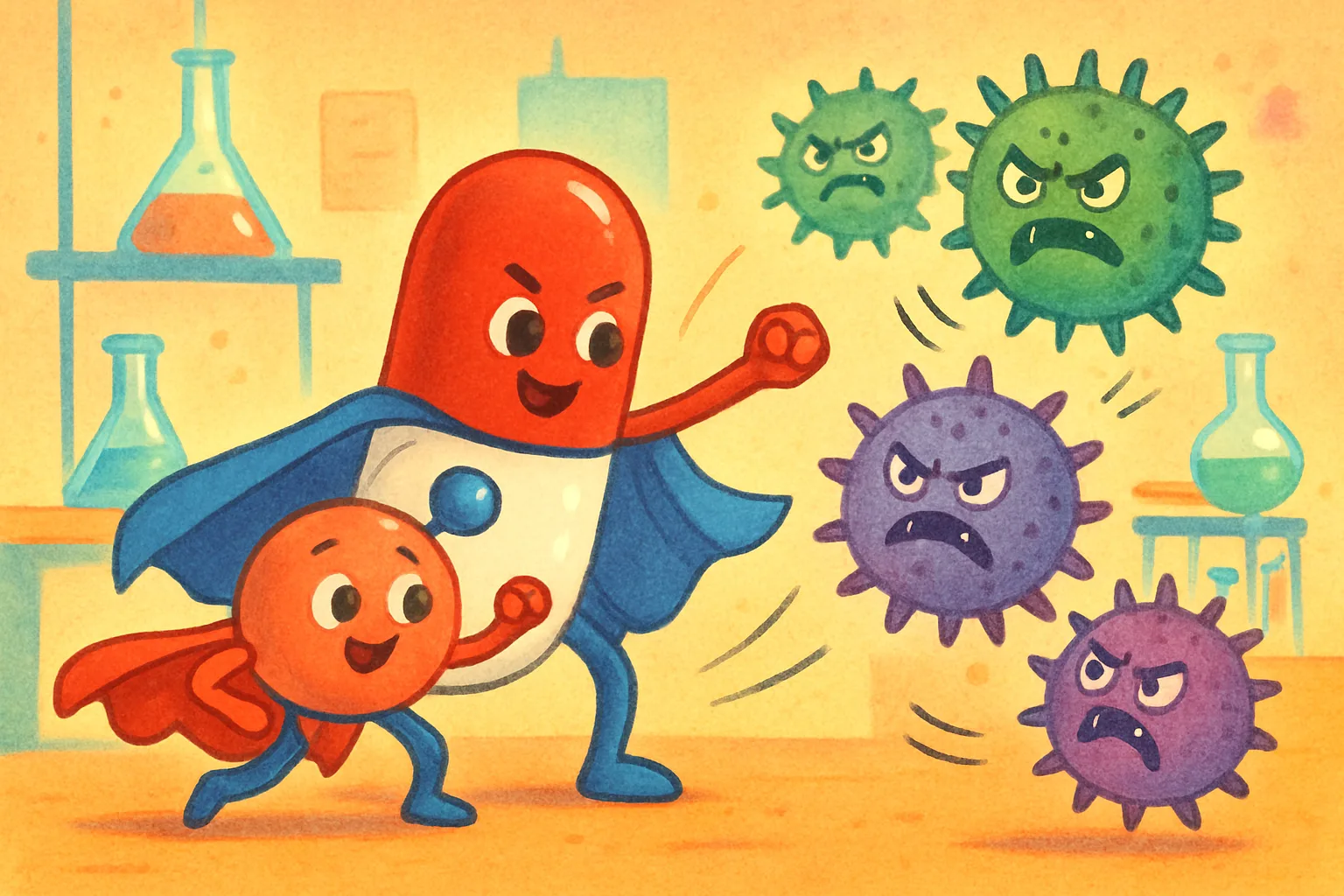
Now, researchers at Cold Spring Harbor Laboratory and Scripps Research have found a brilliant solution. Instead of building a brand-new medicine from scratch — which takes many years — they gave vancomycin a tiny helper molecule called pghi-4. This little helper works like a tool that jams the superbug’s shield. It blocks a key bacterial enzyme called SagA, which the bacteria use to protect themselves.
When scientists combined vancomycin with pghi-4 in the lab, vancomycin regained its power to kill the resistant bacteria. In tests on mice, the combination worked even better — it needed up to eight times less vancomycin than before to do the job. That is a very exciting result.
Why Does It Matter?
Antibiotic resistance is one of the biggest health challenges in the world today. When bacteria become resistant to medicines, even a small cut or a simple surgery can become very dangerous. Finding new ways to make our existing medicines work again is just as important as inventing new medicines. Scientists hope this same approach — using a helper molecule to remove the bacteria’s shield — could work on other stubborn superbugs too, including bacteria that cause tuberculosis.
Big Words
- Antibiotic — A medicine used to kill or slow down bacteria that cause infections in people and animals.
- Superbug — A type of bacteria that has changed over time so that normal antibiotics can no longer kill it.
- Antibiotic resistance — When bacteria evolve and become able to survive medicines that used to kill them.
- Enzyme — A special protein inside a living thing that helps speed up important chemical reactions, kind of like a tiny machine.
- pghi-4 — The tiny helper molecule scientists discovered that blocks the bacteria’s defense shield so vancomycin can do its job again.
Fun Fact
Vancomycin was first discovered in 1958 — that’s almost 70 years ago! Doctors have relied on it for so long that finding a way to keep it working is like restoring a classic superhero after years of retirement.
Think About It
If you were a scientist, would you rather invent a brand-new medicine or find a way to fix an old one? What might be the pros and cons of each approach?
Sources
- ScienceDaily — Scientists Revive a Powerful Antibiotic That Superbugs Had Defeated (July 22, 2026)
- EurekAlert — A Secret Weapon Against Superbugs (Cold Spring Harbor Laboratory)
- News-Medical — New strategy restores vancomycin effectiveness against resistant bacteria
- Cold Spring Harbor Laboratory — A Secret Weapon Against Superbugs