
Look West Tonight! Venus Is Putting on Its Best Show of the Year
Quick Summary
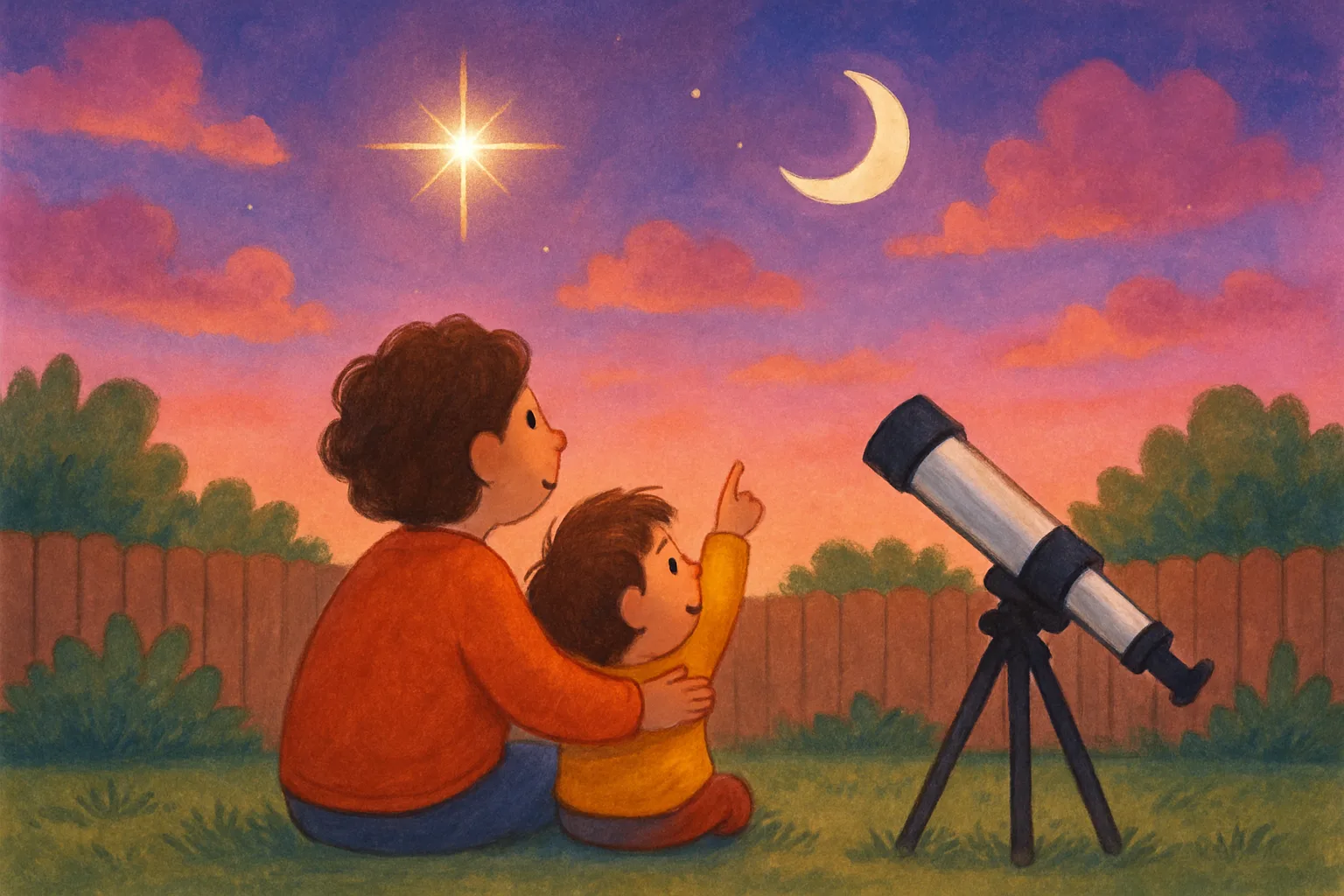
This weekend — August 14 to 16 — Venus is reaching its greatest distance from the Sun in the evening sky. That means it is easier to spot than ever. You do not need a telescope. Just look west after sunset!
What Happened?
You may have noticed a very bright, steady dot glowing in the western sky after the Sun goes down. That is Venus, and right now it is showing off.
Every planet in our solar system moves in its own orbit around the Sun. Venus orbits closer to the Sun than Earth does. Because of that, Venus is always near the Sun in our sky — we can only see it just after sunset or just before sunrise. Most of the time, it is hidden in the bright glow of the Sun.
But right now, Venus has swung to its widest point away from the Sun as seen from Earth. Astronomers call this “greatest elongation.” Think of it like a dog on a leash. Venus is always connected to the Sun by that invisible leash. Greatest elongation is the moment when the leash stretches as far as it can go — making Venus as easy to see as possible.
NASA says to look low in the western sky about 30 to 45 minutes after sunset. Venus will be the brightest thing in the sky besides the Moon. It shines so steadily and so brilliantly that it outshines every single star. You cannot miss it.
If you have a small telescope or binoculars, you will see something cool: Venus looks almost half-lit right now, like a tiny half-Moon. That is because the Sun is lighting up one side of it, just like the Sun lights up one side of our Moon.
Bonus: the crescent Moon will appear near Venus in the sky on August 15 and 16. What a pair to spot!
Why Does It Matter?
Venus is sometimes called Earth’s twin because it is almost the same size as our planet. But it is actually very different — it is covered in thick clouds of sulfuric acid, and its surface is hot enough to melt lead. Even though it is not very friendly to life, it is one of the most spectacular sights in our sky.
August 2026 is a special month for sky-watching. There was a total solar eclipse on August 12, the Perseid meteor shower peaked last weekend, and now Venus is glowing at its best. A partial lunar eclipse is also coming on August 27. It is one of the greatest months for looking up in years!
Venus will continue to be visible in the evening sky through October before slowly fading again.
Big Words
- Elongation — the angle between a planet and the Sun, as seen from Earth; greatest elongation is when this angle is at its widest.
- Orbit — the curved path one object in space takes around another, like Earth around the Sun.
- Inner planet — a planet whose orbit is closer to the Sun than Earth’s; Mercury and Venus are Earth’s inner planets.
- Magnitude — a number scientists use to measure how bright something looks in the sky; a smaller or more negative number means brighter.
Fun Fact
Venus is the third brightest object in our sky, behind only the Sun and the Moon. It is so bright that some people have called police thinking they spotted a UFO — not realizing it was just Venus!
Think About It
If you could stand on Venus and look up, would you see Earth shining in the sky? What do you think it would look like?
Sources
- NASA Science — What’s Up: August 2026 Skywatching Tips from NASA
- EarthSky — Venus greatest distance from the sun August 14–15, 2026
- Farmers’ Almanac — August 2026 Night Sky Guide
- NatureWorldNews — Venus Hits Its Widest Evening Separation from the Sun