
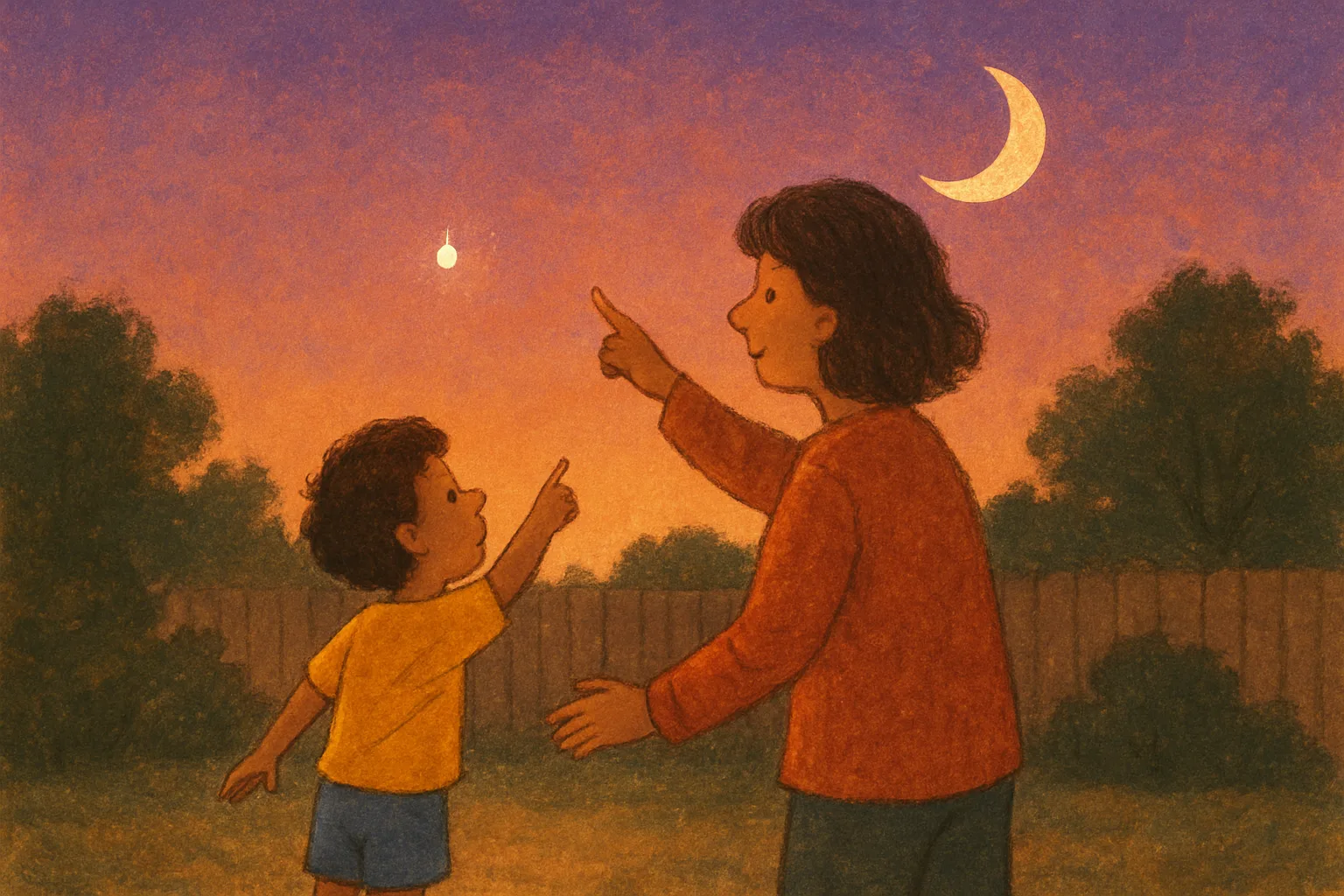
Look Up Tonight! Venus Is at Its Absolute Brightest of the Year
Quick Summary
Tonight is a special night for skywatchers! Venus — our closest planetary neighbour — reaches its peak brightness of all of 2026. You can spot it with your own eyes, no telescope needed. Just look west after sunset.
What Happened?
Venus is always one of the brightest objects in our night sky, but tonight it reaches what astronomers call its greatest brilliancy. NASA confirms that September 18 is the date Venus shines at its very best during its 2026 evening appearance.
At its peak tonight, Venus will shine at magnitude -4.8 on the astronomer’s brightness scale. To put that in perspective, the full Moon shines at about -12. But among planets and stars, Venus is extraordinary — about 19 times brighter than Sirius, the very brightest star you can see at night. It is the third-brightest natural object in the entire sky, beaten only by the Sun and the Moon.
Here is a cool scientific twist: Venus is not brightest when it looks like a full, round disk. Right now, Venus appears as a crescent through a telescope — like a tiny sliver Moon. It is brightest now because it is close to Earth and a large enough part of it is lit by the Sun. Think of it like holding a crescent-shaped mirror up close to a lamp — the crescent reflection can still be dazzling.
Venus looks so brilliant partly because of its thick, shiny cloud cover. Those clouds act like a giant mirror, bouncing sunlight right back into space toward us. The clouds also make Venus the hottest planet in our Solar System, even though Mercury is closer to the Sun.
To find Venus tonight, step outside shortly after sunset and look toward the western horizon. It will be the brightest dot in the sky, clearly outshining everything around it. Have a clear view to the west if you can — Venus sits fairly low in the sky and will set about an hour after the Sun.
After tonight, Venus will gradually drift lower toward the horizon over the coming weeks. It will not appear this bright in the evening sky again until April 2028. So tonight is really the moment to look!
Why Does It Matter?
Venus has fascinated humans for thousands of years. Ancient civilisations thought it was two separate stars — one they saw at dawn and one at dusk — before they worked out it was the same planet.
Skywatching is one of the easiest and most magical ways to connect with the universe. All you need is clear skies and curious eyes.
Big Words
- Greatest brilliancy — The moment when a planet appears at its very brightest as seen from Earth.
- Magnitude — The number astronomers use to measure the brightness of objects in the sky. Lower numbers (and negative numbers) mean brighter objects.
- Crescent — A curved, sliver shape — like the thin edge of a circle. The Moon and inner planets like Venus can look crescent-shaped from Earth.
- Inferior planet — A planet whose orbit is closer to the Sun than Earth’s orbit. Venus and Mercury are both inferior planets.
- Horizon — The line in the distance where the sky appears to meet the ground.
Fun Fact
Venus spins so slowly that one day on Venus is longer than one year on Venus! It takes 243 Earth days to spin once, but only 225 Earth days to go all the way around the Sun.
Think About It
If you could travel to Venus, you would find scorching temperatures of around 465°C — hot enough to melt lead! Why do you think scientists still want to send spacecraft there, even knowing how extreme the conditions are?
Sources
- NASA Jet Propulsion Laboratory — What’s Up: September 2026 Skywatching Tips from NASA
- EarthSky — Venus brightest in the evening sky this week
- National Geographic — Venus Is Putting on a Dazzling Show This Month