
Don’t Turn Off Yet! NASA’s Clever Trick Keeps the Voyager Probes Flying
Quick Summary
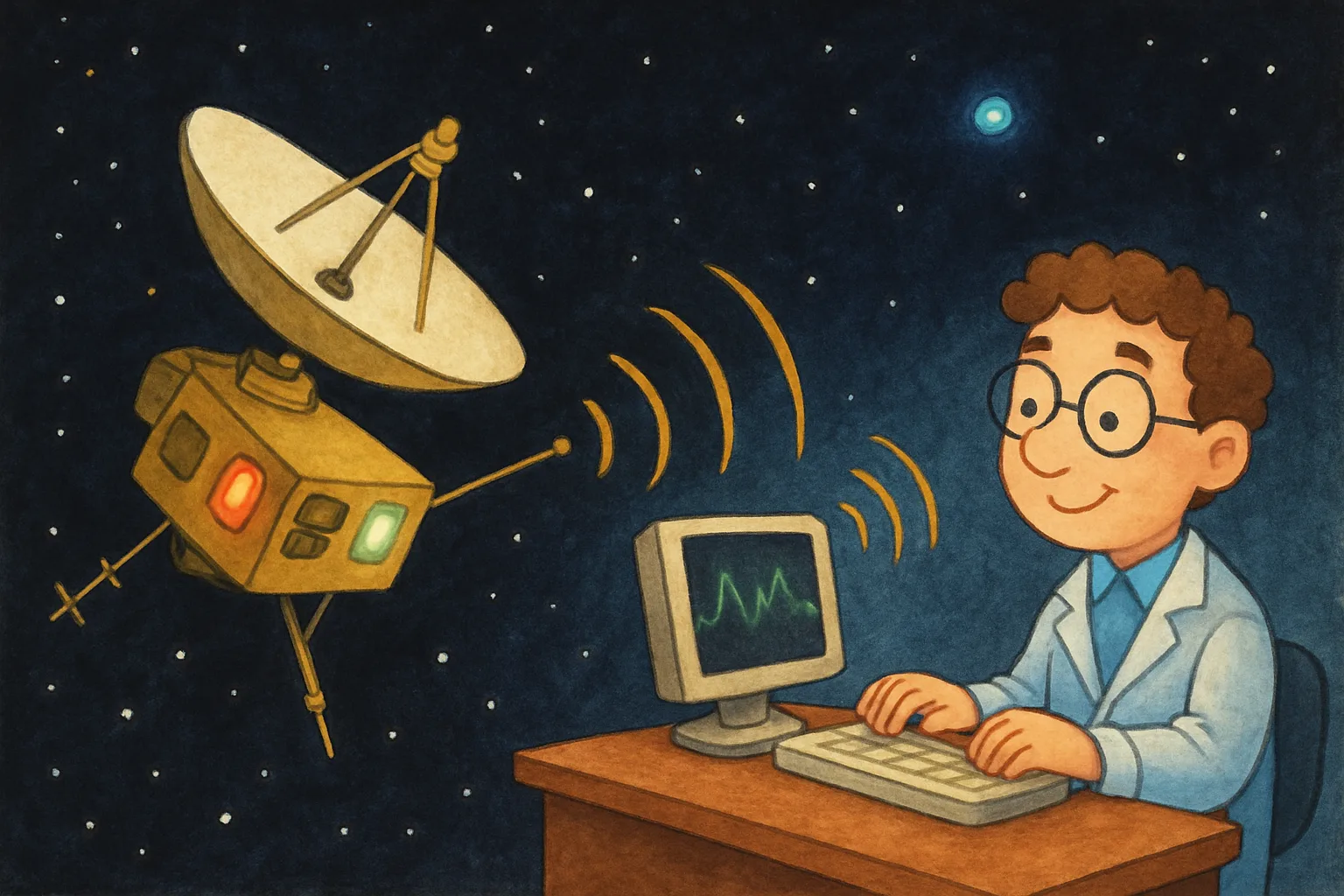
NASA’s two Voyager spacecraft have been flying through space for almost 50 years. They are running very low on power. But NASA engineers just pulled off a clever energy-saving fix on one of them — and the same fix is now planned for the other!
What Happened?
The two Voyager probes — Voyager 1 and Voyager 2 — were launched way back in 1977. That was the year Star Wars first hit movie theaters. Their original mission was to fly past Jupiter and Saturn and snap photos. But they kept going, and going, and going.
Today, Voyager 1 is the most distant human-made object ever. It is more than 15 billion miles from Earth. If you drove a car at highway speed, it would take you over 17 million years to get there. Radio signals from the spacecraft, traveling at the speed of light, take more than 23 hours just to reach us.
Both Voyagers run on a special power system. It uses heat from a slowly decaying piece of metal called plutonium-238 and turns that heat into electricity. But plutonium naturally loses its heat over time. Each year, the spacecraft lose about 4 watts of power — roughly the same as a very dim night light. After nearly 50 years, that really adds up.
NASA engineers at JPL — the Jet Propulsion Laboratory near Los Angeles — had to act fast. They came up with a plan they nicknamed the “Big Bang.”
Here is how the Big Bang works. Normally the spacecraft uses several heaters and old devices to keep important parts warm enough to function. The engineers figured out a clever swap: turn off some of the power-hungry older devices and turn on different ones that do the same job using less power. Done all at once — like a big swap — the trick saved almost 10 watts per year without letting anything freeze.
First, they tried it on Voyager 2. NASA announced on August 4, 2026 that the Big Bang worked perfectly on Voyager 2! Its cosmic ray detector, which was about to be turned off forever to save power, now gets to keep running for at least another year.
Voyager 2 is roughly 13 billion miles from Earth. It still has three science instruments running. Voyager 1, the farther twin, is down to two.
Now NASA engineers are preparing to run the same Big Bang fix on Voyager 1 in the coming months. It is riskier because Voyager 1 is farther away and has less power to spare — meaning any mistake would be harder to fix.
The goal is to keep at least one science instrument running on both spacecraft well into the 2030s. Even with fading power, the Voyagers are still sending back measurements of what deep interstellar space looks like — a place no other spacecraft has ever been.
Why Does It Matter?
The Voyager probes are one of humanity’s greatest achievements. They were built with 1970s technology — computers far less powerful than a calculator app on your phone. And yet they are still working, billions of miles away, in a region of space we have never visited before.
Every measurement they send back teaches scientists something new about the boundary between our solar system and the vast galaxy beyond it. And it shows that with creative thinking, engineers can keep incredible machines alive far longer than anyone expected.
Voyager 1 has a special milestone coming up later this year. In November 2026, it will reach a distance of exactly one light-day from Earth. That means its radio signal will take a full 24 hours to reach us — one complete day, just to cover the space between the spacecraft and home.
Big Words
- Interstellar space — the region of space beyond our solar system, between the stars
- Plutonium-238 — a radioactive metal that slowly releases heat, which spacecraft use to make electricity
- JPL (Jet Propulsion Laboratory) — NASA’s main center for robotic spacecraft near Los Angeles, California
- Watt — a unit for measuring how much power something uses; a night light uses about 4–7 watts
- Light-day — the distance light can travel in one full day, about 16 billion miles
Fun Fact
The Voyager probes carry a special “Golden Record” — a gold-plated disc with sounds and images from Earth, including music, animal sounds, and greetings in 55 languages. It was designed as a message to any intelligent life that might someday find the spacecraft.
Think About It
If you could send one sound from Earth on the Voyager’s Golden Record to represent your life today, what would you choose — and why?
Sources
- NASA Science Blog / JPL — NASA Shuts Off Instrument on Voyager 1 to Keep Spacecraft Operating (Apr. 17, 2026)
- Gizmodo — Upcoming Hack to Keep NASA’s Voyager 1 Alive Exploits a Quirk in Its 1970s Hardware (Aug. 7, 2026)
- Live Science — NASA grants Voyager 2 spacecraft another year of power with risky ‘Big Bang’ maneuver (Aug. 7, 2026)
- The Register — Voyager 2 cheats the power budget for another year (Aug. 5, 2026)
- WatchTheStars.co.uk — Voyager 2 ‘Big Bang’ Power Fix: NASA Buys Another Year (Aug. 9, 2026)