
Lost in Space! A Giant Black Hole Was Caught Wandering Far From Home
Quick Summary
Black holes are usually found at the very centers of galaxies, like a drain at the bottom of a bathtub. But astronomers just found one that is completely off on its own — wandering in the outer edges of its galaxy, far from the center. A dying star gave it away.
What Happened?
Astronomers at the University of Maryland were scanning the sky in November 2025 when they spotted something extraordinary. A star in a distant galaxy suddenly flared up brighter than 10 billion suns. Then it quickly faded away.
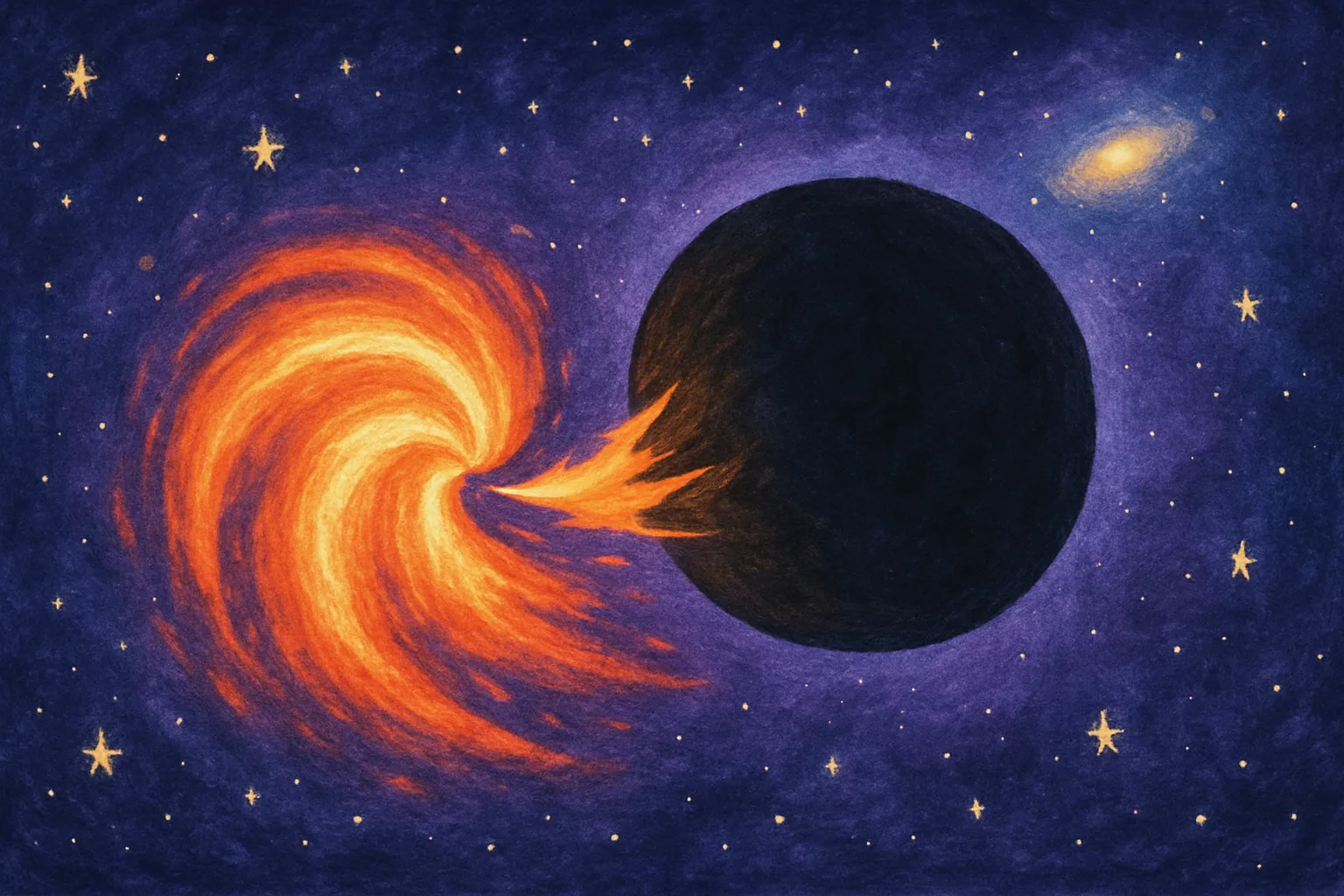
That kind of flash has a name: a tidal disruption event, or TDE. It happens when a star wanders too close to a black hole. The black hole’s gravity is so powerful that it tears the star apart, like a giant invisible hand ripping cotton candy in two. As the star is destroyed, it releases a huge burst of light.
Here is the surprising part. When scientists looked at where the flash came from, it was not in the center of the galaxy. It was about 30,000 light-years away from the center — far out in the galaxy’s outer edges. One light-year is about six trillion miles. So 30,000 light-years is an almost unimaginable distance.
The black hole causing all this is about four million times more massive than our Sun — roughly the same size as the black hole at the center of our own Milky Way galaxy. But this one has no galaxy of its own surrounding it.
The findings were published in a science journal called Astrophysical Journal Letters.
Why Does It Matter?
Black holes are normally very hard to see. They do not give off light. This one was completely invisible and unknown until a star happened to stumble into it.
Scientists think this black hole was probably kicked out of its galaxy’s center a long time ago, when two galaxies crashed together. Like a marble bouncing off the edge of a bowl, it got flung outward and has been drifting ever since.
Discovering it means there could be many other wandering black holes hiding silently in the darkness around galaxies — including maybe our own Milky Way. Scientists say there is nothing to worry about, though. Space is enormous, and the chance of one coming close to us is incredibly tiny.
Big Words
- Supermassive black hole — an enormously massive black hole, usually found at a galaxy’s center, that can be millions or billions of times heavier than our Sun
- Tidal disruption event (TDE) — when a star gets too close to a black hole and is ripped apart by the black hole’s gravity, releasing a burst of bright light
- Galaxy — a giant collection of billions of stars, gas, and dust all held together by gravity; our own galaxy is the Milky Way
- Light-year — the distance light travels in one whole year, which equals about 6 trillion miles — so long that if you drove a car nonstop, it would take 225 million years to cover just one light-year
- Dormant — resting or inactive; a dormant black hole is not swallowing anything and gives off no light, making it almost impossible to detect
Fun Fact
The flash produced when this black hole tore apart the star was brighter than 10 billion suns all at once — but because it happened 750 million light-years away, it looked like just a tiny dot of light through telescopes on Earth!
Think About It
If wandering black holes are invisible unless a star blunders into them, how do you think scientists could go about searching for the ones that might be hiding right now?
Sources
- ScienceDaily / University of Maryland — ‘A star’s violent death exposed a hidden supermassive black hole’ (Aug 5-6, 2026)
- Scientific American — ‘Astronomers spot best-yet example of a wandering supermassive black hole’ (Aug 2026)
- Sci.News — ‘Astronomers Spot Wandering Supermassive Black Hole Far From Its Galaxy’s Heart’ (Aug 2026)
- Sky & Telescope — ‘Wandering Supermassive Black Hole Found at the Edge of its Galaxy’ (Aug 2026)