
Lopsided! Webb Telescope Finds a Planet That Is Puffed Up on One Side
Quick Summary
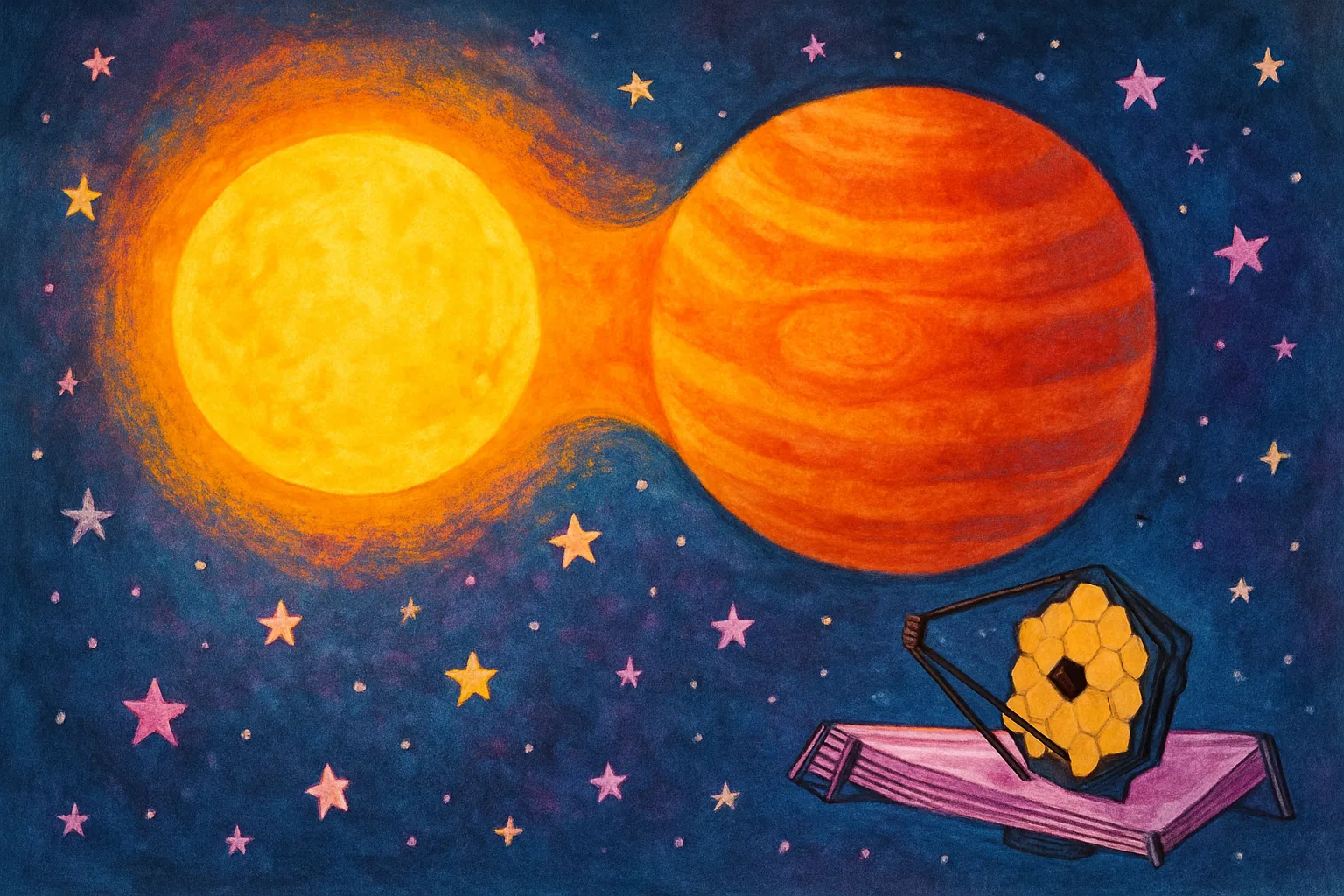
NASA’s James Webb Space Telescope has spotted something wild: a giant planet 1,300 light-years away has an atmosphere that sticks out much farther on one side than the other. Scientists call it “lopsided.” Think of it like a balloon that someone squeezed so one end is bigger and puffier.
What Happened?
Astronomers around the world were studying a gas giant planet called WASP-17b. It lives very far from us — about 1,300 light-years away, which is so distant that even the fastest spaceship ever built would take millions of years to get there. Scientists used the James Webb Space Telescope to look at it closely.
WASP-17b is what scientists call a “hot Jupiter.” It is a huge gas planet, similar to Jupiter in our solar system, but it orbits extremely close to its star. It goes around that star in just a few days. One side of the planet always faces the star and stays boiling hot. The other side is always in darkness.
Because one side is so much hotter, strong winds blast around the planet carrying heat from the sunny side to the dark side. This creates something amazing: the atmosphere on the warm evening side of the planet is stretched out much taller than on the cooler morning side. The evening side’s atmosphere reaches about 1.8 times as high as the morning side’s. The evening side is also roughly 1,200 degrees Fahrenheit hotter — that is hotter than molten lava!
Scientists at Cornell University and the University of Bristol developed a clever new mapping method to spot this lopsidedness. They watched the planet cross in front of its star and measured exactly how much atmosphere was present at different spots around the planet’s edge.
Why Does It Matter?
Before this discovery, scientists mostly had to treat a planet’s atmosphere like one uniform ring — the same all the way around. Now, for the first time, they can track how the atmosphere changes from one part of a planet to another. It is like going from one blurry weather symbol on a map to seeing an actual weather forecast.
This new technique could be used on many other planets far away. Someday, it might even help scientists check whether other worlds have the kinds of conditions needed for life.
Big Words
- Exoplanet — a planet that orbits a star other than our Sun; there are thousands known to exist
- Hot Jupiter — a nickname for a very large gas planet that orbits extremely close to its star, making it scorching hot
- Atmosphere — the layer of gases that surrounds a planet, like Earth’s air
- Transmission strings — the new scientific method used to map how a planet’s atmosphere changes at different points around its edge
- Transit — when a planet passes in front of its star as seen from Earth, like a tiny shadow crossing a bright light
Fun Fact
WASP-17b is one of the puffiest known planets in the universe! Even though it is several times more massive than Jupiter, it is so inflated by the heat of its star that it is actually less dense than a swimming pool full of water.
Think About It
If you lived on a planet where one side was always day and the other was always night, which side would you want to live on — and why?
Sources
- ScienceDaily / University of Bristol — James Webb reveals a strange bulge in an alien planet’s atmosphere, Oct 16 2026
- Earth.com — Webb telescope discovers a distant planet that isn’t quite round, Oct 16 2026
- Knowridge Science Report — Webb reveals a giant alien planet with a lopsided atmosphere, Oct 17 2026
- Daily Galaxy — A Scorching Alien World Is Hiding an Atmospheric Imbalance That Webb Has Finally Exposed