
Crash Course! Webb Telescope Spots Planets Smashing Into Each Other
Quick Summary
NASA’s powerful James Webb Space Telescope has spotted rare clues about giant worlds crashing into each other in young solar systems far away. The discovery helps scientists understand how our own Moon may have formed — from a mega-collision billions of years ago. Think of it as a window into our solar system’s wild, rocky past.
What Happened?
A team of scientists used the Webb telescope to study 21 special regions around young stars. These regions are called “extreme debris disks.” They are filled with warm dust and bits of rock floating in space.
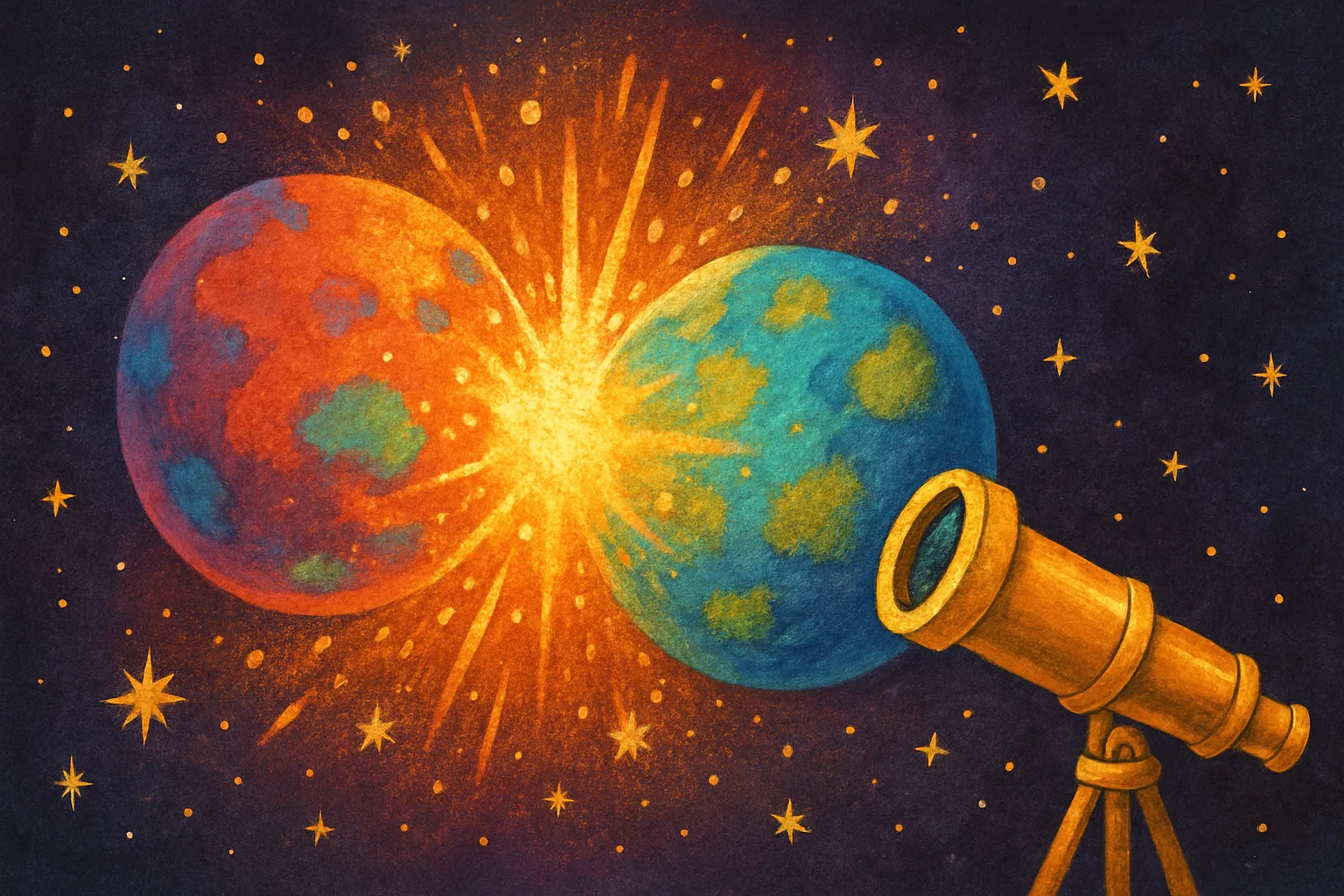
What caused all that dust? Giant worlds smashing into each other! The scientists found that some of these disks were created when planet-sized objects — roughly the size of Mars — crashed together at enormous speeds. When that happens, the rocky worlds don’t just dent each other. They vaporize into clouds of dust. Think of smashing two enormous chalk boulders together and watching them explode into powder — except each boulder is the size of an entire planet.
The dust from these crashes gives off a faint warmth that Webb can detect, even from trillions of miles away. Scientists sorted the disks into two types: those rich in a mineral called silica, which come from the biggest, most energetic crashes, and those with less silica, from smaller collisions.
Only about 1 out of every 100 young stars shows signs of these dramatic crashes. That makes these systems very rare and very special to study.
Why Does It Matter?
Scientists believe something similar happened in our own solar system, long before you or anyone else was alive. A Mars-sized object may have slammed into the young Earth. The crash sent enormous amounts of rock flying into space. Over time, that rocky material clumped together and formed the Moon.
By watching these crashes happen right now around other stars, scientists can test that idea. It is like watching the same recipe play out in other kitchens, to make sure you have the right ingredients for your own dish.
The study was published in a science journal called The Astrophysical Journal.
Big Words
- Extreme debris disk — a ring of warm dust and broken rock around a young star, created when worlds collide
- Silica — a common mineral found in sand and rock; when it shows up in space dust, it signals a very powerful crash
- Vaporize — to turn something solid into a gas or cloud of tiny particles from extreme heat or force
- Theia — the name scientists give to the ancient Mars-sized object thought to have crashed into young Earth, helping create our Moon
- Infrared — a type of invisible light that shows heat; the Webb telescope uses it to “see” warm dust that regular cameras cannot detect
Fun Fact
The James Webb Space Telescope can detect the faint warmth of dust clouds around stars that are billions of miles away. Its mirror is so large that if it were laid flat, a school bus could park on it with room to spare!
Think About It
If crashing planets helped build our Moon, what other amazing things in our solar system might have formed from a big collision?
Sources
- NASA/ScienceDaily — NASA’s Webb Finds Signs of Mars-Sized Worlds Smashing Together (Oct. 7, 2026)
- Space.com — Worlds collide! James Webb Space Telescope investigates what happens when planets crash together (Oct. 6, 2026)
- Phys.org — Webb provides crash course on planet-shattering collisions (Oct. 7, 2026)
- The Astrophysical Journal — Extreme Debris Disks study, published Oct. 1, 2026