
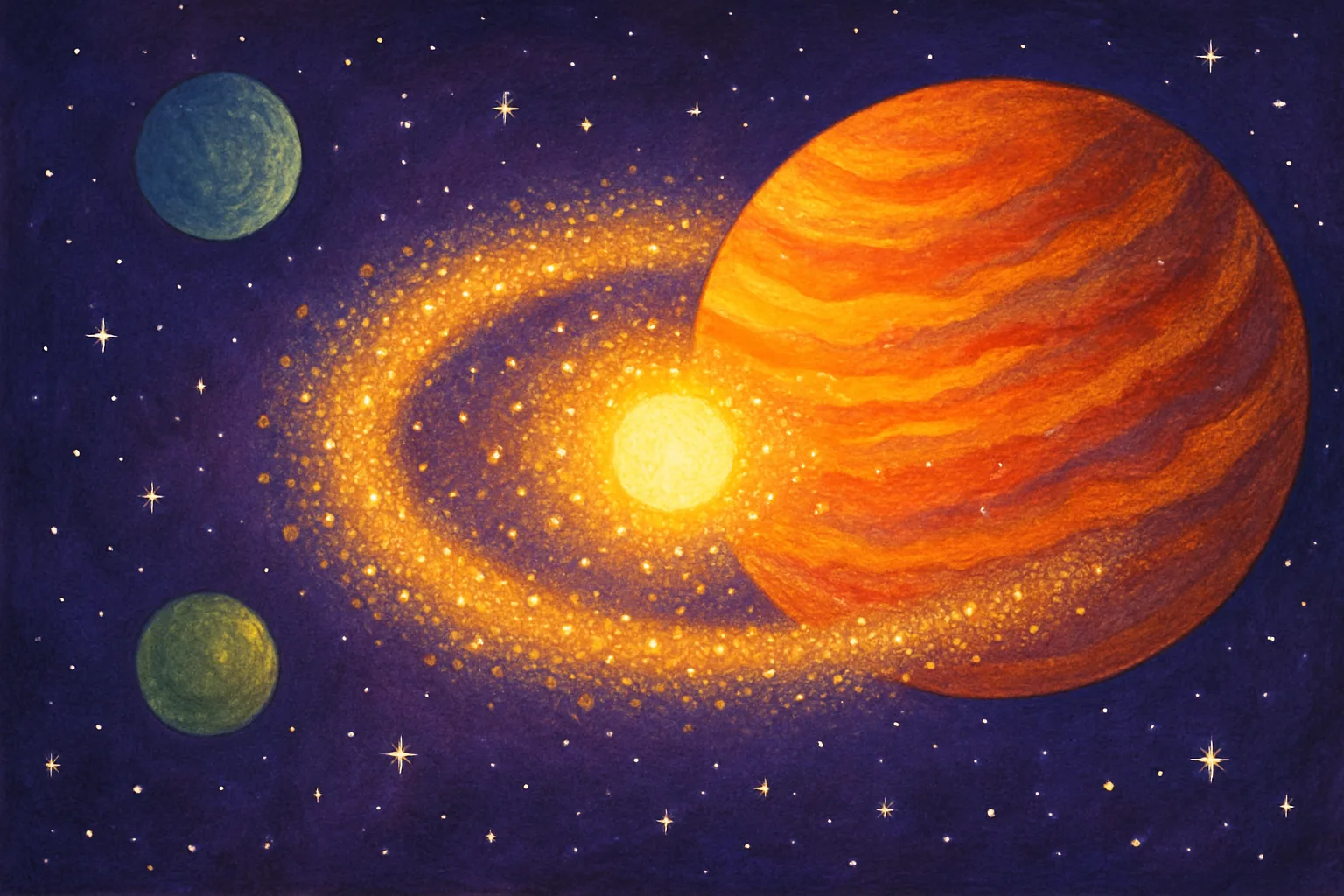
Surprise! The Webb Telescope Found a Secret Planet That Was Hiding in Plain Sight
Quick Summary
NASA’s James Webb Space Telescope found a brand-new planet hiding inside one of the most-studied star systems in the galaxy. Scientists didn’t spot it by seeing it — they found it by smelling its air! It’s a giant world, and it was right under astronomers’ noses the whole time.
What Happened?
About 63 light-years from Earth — that’s nearly 370 trillion miles away — sits a young star called Beta Pictoris. Astronomers have been studying this star for decades. They already knew it had two giant planets orbiting it.
But the James Webb Space Telescope just spotted a third one.
The new planet is called Beta Pictoris d. Here’s the tricky part: Webb didn’t find it by taking a photo. Instead, it detected chemicals in the planet’s atmosphere — a mix of carbon monoxide, water vapor, and methane drifting in space. It’s a bit like finding someone hiding in a room by noticing their smell before you can see them.
This planet is enormous. Scientists think it’s at least twice as heavy as Jupiter, which is already the biggest planet in our solar system. It orbits its star at a huge distance — about 30 times farther than Earth is from the Sun. Imagine walking to your nearest grocery store, and this planet is 30 times farther away from its star than that.
The planet was hidden this whole time inside a bright cloud of dust surrounding the star. Even our best telescopes couldn’t see through that cloud. Webb’s super-powerful infrared vision finally cracked the case.
Why Does It Matter?
This discovery is exciting for two big reasons. First, it proves that even systems we’ve studied for many years can still hold big surprises. Second, it shows astronomers a brand-new way to find planets — by reading their atmospheric chemical fingerprints. That technique could help scientists find many more hidden worlds in the future.
Beta Pictoris is now only the second star system ever known to have at least three planets that have been spotted this way. Scientists will keep studying Webb’s data to learn more about this mystery world’s orbit, temperature, and atmosphere.
Big Words
- Exoplanet — a planet that orbits a star other than our own Sun
- Atmosphere — the layer of gases surrounding a planet; Earth’s atmosphere has the air we breathe
- Infrared — a type of light that humans can’t see with their eyes but that telescopes like Webb can detect; it’s like the “heat glow” coming off warm objects
- Light-year — the distance light travels in one year — about 5.88 trillion miles; it’s used to measure the enormous distances between stars
- Spectroscopy — the science of breaking light apart into colors to figure out what chemicals something is made of, like a fingerprint for substances
Fun Fact
Beta Pictoris is a very young star — only about 23 million years old. Our own Sun is about 4.6 billion years old, making it roughly 200 times older. The Beta Pictoris system is basically still a baby!
Think About It
Scientists found this planet by detecting its atmosphere instead of seeing it directly. What other ways can you think of to find something you can’t see?
Sources
- NASA Science — NASA’s Webb Discovers Hidden Planet in Famous Star System
- Space Telescope Science Institute (STScI) — NASA’s Webb Discovers Hidden Planet in Famous Star System
- ScienceDaily — NASA’s Webb Telescope Discovers Giant Planet Hiding in One of Astronomy’s Most Famous Systems
- Phys.org — Webb telescope discovers hidden planet in famous star system
- SciTechDaily — James Webb Telescope Discovers Hidden Giant Planet in Famous Star System