
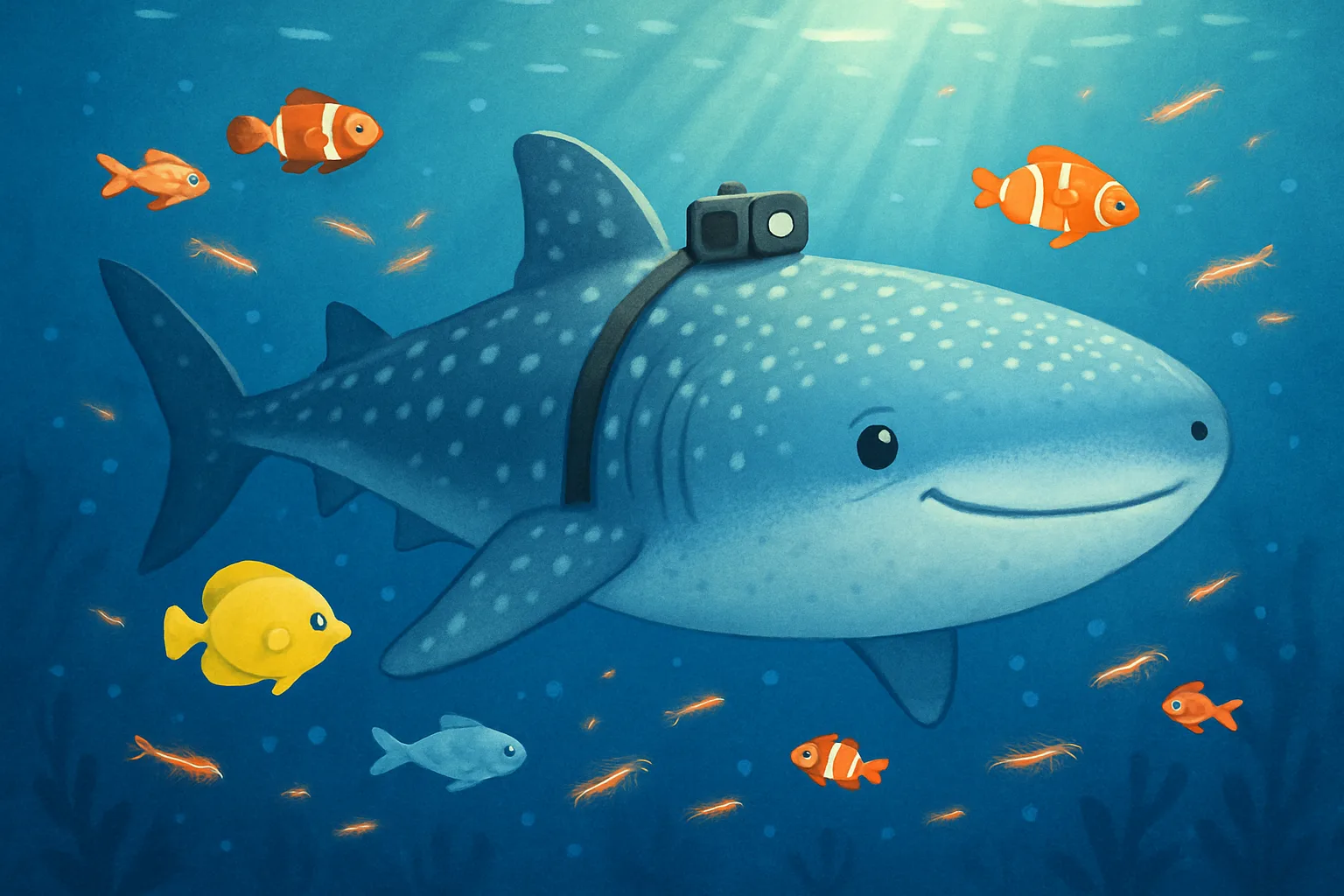
Whale Sharks Got GoPros! Scientists Finally See What They Do Underwater
Quick Summary
Scientists have strapped cameras onto whale sharks — the biggest fish on Earth — for the very first time. What they saw surprised everyone. These gentle giants spend most of their time doing secret underwater snacking that nobody had ever witnessed before.
What Happened?
Whale sharks are enormous. They can grow up to 18 metres long — about as long as three school buses parked end to end. They are also gentle filter feeders, which means they swim slowly with their mouths open, scooping up tiny creatures like krill and plankton.
For years, most of what scientists knew about whale sharks came from watching them from the surface of the water or from boats. But whale sharks spend a lot of time deep below the surface, where human eyes cannot follow.
Researchers from the Australian Institute of Marine Science and Murdoch University in Western Australia decided to fix that. They attached special camera tags to five whale sharks at Ningaloo Reef, a famous marine park off the coast of Western Australia where whale sharks gather every year to feed.
The cameras recorded just 24 hours of footage each. But that was enough to completely change what science knows about these gentle giants.
The cameras caught the sharks doing six never-before-seen feeding behaviors. One was called “gliding slow feeding” — where the shark sinks slowly through the water with its enormous mouth open, scooping up prey like a living net. Another was “dive feeding” — where the shark plunges straight down toward the sea floor to snap up as much food as possible.
The research team described 36 different behaviors in total — and 12 of them were related to eating. Scientists built what they called the largest catalog of whale shark behaviors ever created, all from just one day of camera footage per shark.
Why Does It Matter?
Whole shark sharks are listed as endangered. That means their numbers in the wild are dangerously low, and we need to protect them. But to protect an animal, you first need to understand it.
By learning exactly how whale sharks find and eat their food, scientists can better protect the ocean areas they depend on. Ningaloo Reef in Australia, for example, turns out to be an extremely important “pantry” for whale sharks — a safe place where they come to snack and build their strength.
This research shows that even the ocean’s biggest animals still have secrets. And sometimes, all it takes is a tiny camera to unlock them.
Big Words
- Filter feeder — An animal that eats by swimming through the water with its mouth open, filtering out tiny creatures like krill and plankton to swallow.
- Krill — Tiny shrimp-like creatures that live in the ocean in massive swarms; many large sea animals, including whale sharks and whales, eat them.
- Behavior catalog — A complete list of all the actions a type of animal is known to perform, like a dictionary of what the animal does.
- Endangered — When a species has so few individuals left in the wild that it is at risk of disappearing forever.
- Marine biologist — A scientist who studies animals and plants that live in the ocean.
Fun Fact
Whale sharks are not actually whales — they are fish! They got the name “whale shark” because of their enormous whale-like size. They are the biggest fish species on the entire planet.
Think About It
If you could attach a camera to any animal in the world for 24 hours to discover its secrets, which animal would you choose — and what do you think you might see?
Sources
- Live Science — ‘Scientists put cameras on whale sharks for the first time and saw something they’d never seen before’, July 30, 2026
- Phys.org — ‘Cameras on whale sharks reveal they are the snackers of the sea’, July 21, 2026
- Yahoo News / The New Daily — ‘We attached cameras to whale sharks and captured krill chases never seen before’, July 27, 2026
- Marine Biology journal — Barry, C. & Ferreira, L.C. et al, ‘An ethogram for the whale shark (Rhincodon typus) with insights into foraging plasticity’, 2026