
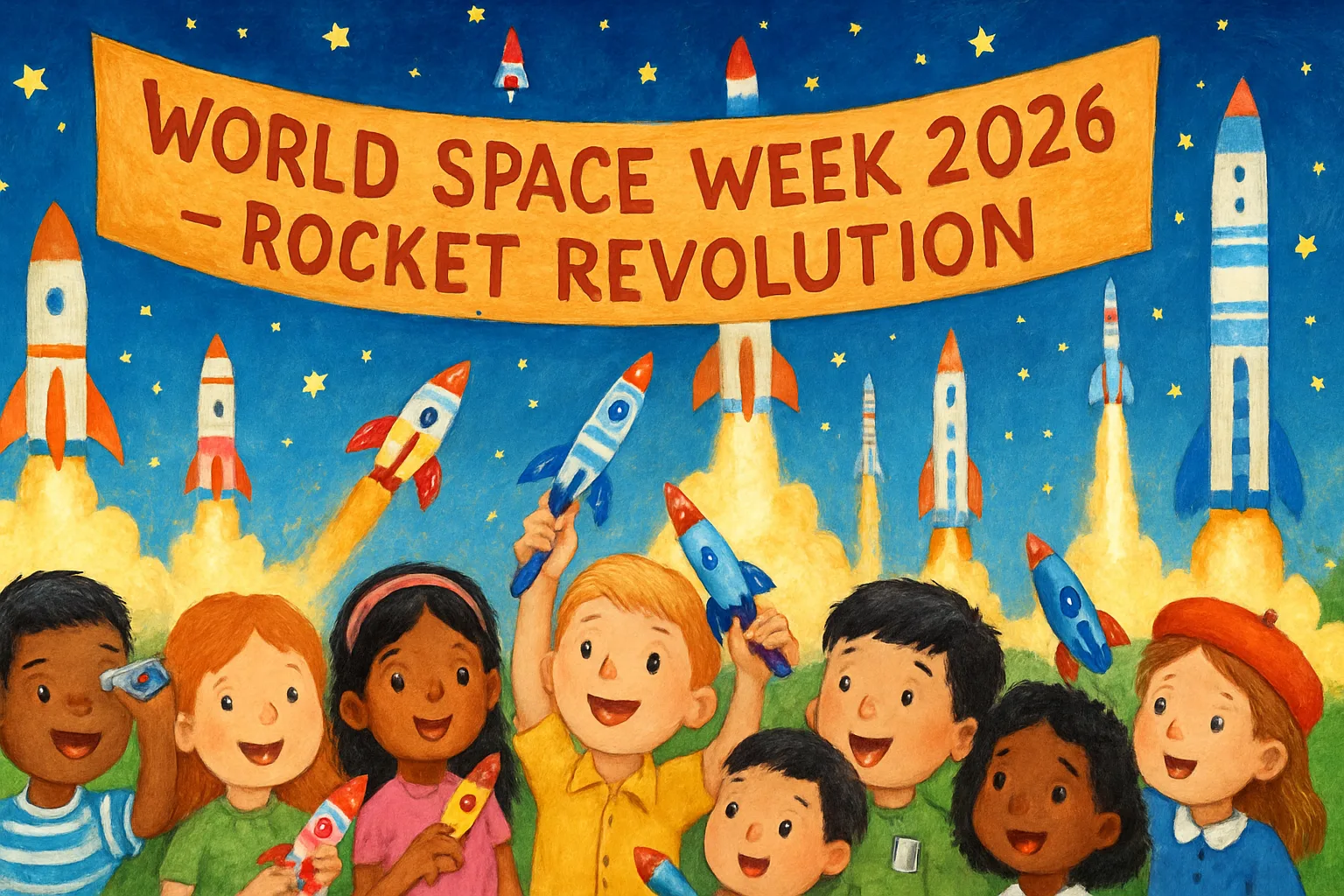
Rocket Revolution! World Space Week Blasts Off Today
Quick Summary
Today, October 4, marks the start of World Space Week 2026! For seven days, people in more than 100 countries will celebrate space science together. This year’s theme is all about rockets — and how anyone, not just big governments, can now reach space.
What Happened?
World Space Week runs every year from October 4 to October 10. The United Nations chose those dates on purpose. October 4 marks the anniversary of Sputnik 1, the very first satellite ever launched into space. That happened back in 1957 — almost 70 years ago! October 10 marks the anniversary of the Outer Space Treaty, a big agreement signed in 1967 that set rules for how countries explore space peacefully.
This year’s theme is called The Rocket Revolution. For decades, only a handful of powerful governments could afford to build and launch rockets. Now things are changing fast. Private companies, universities, small startups, and brand-new national space programs are all joining in. Reusable rockets — ones that land back on Earth and fly again — have made reaching orbit much cheaper and more common.
World Space Week hopes to show students everywhere that space careers are closer than ever. Tens of thousands of events are planned around the globe — from school rocket-building contests and planetarium shows to stargazing parties and satellite-spotting nights. Last year, nearly 50,000 events were held across 102 countries.
Why Does It Matter?
More people reaching space means more science gets done. Weather satellites, GPS, internet connections, and climate research all depend on objects in orbit. As rockets get cheaper and more powerful, space stops being just for astronauts and becomes something that affects everyone’s daily life. World Space Week gives students a chance to imagine being part of that future.
Big Words
- Satellite — an object that orbits, or circles, a planet; Earth has thousands of human-made satellites in space right now
- Reusable rocket — a rocket that can land safely after launching and be flown again, like an airplane instead of a paper plane you crumple up
- Orbit — the curved path an object follows as it travels around a planet or star
- Commercial — made or run by a private company rather than a government
- STEM — short for Science, Technology, Engineering, and Mathematics, the subjects connected to space careers
Fun Fact
Sputnik 1, the satellite that started the space age on October 4, 1957, was about the size of a beach ball — only 23 inches (58 centimeters) across! It beeped a radio signal as it zoomed around Earth.
Think About It
If you could design a satellite and launch it into space, what would you want it to do — and why?
Sources
- EarthSky — ‘World Space Week is October 4 to 10. Find events here’
- AwarenessDays.com — ‘World Space Week 2026: 4-10 October 2026’
- Planetary.org — ‘World Space Week 2026’
- SpaceAgenda.com — ‘World Space Week’