
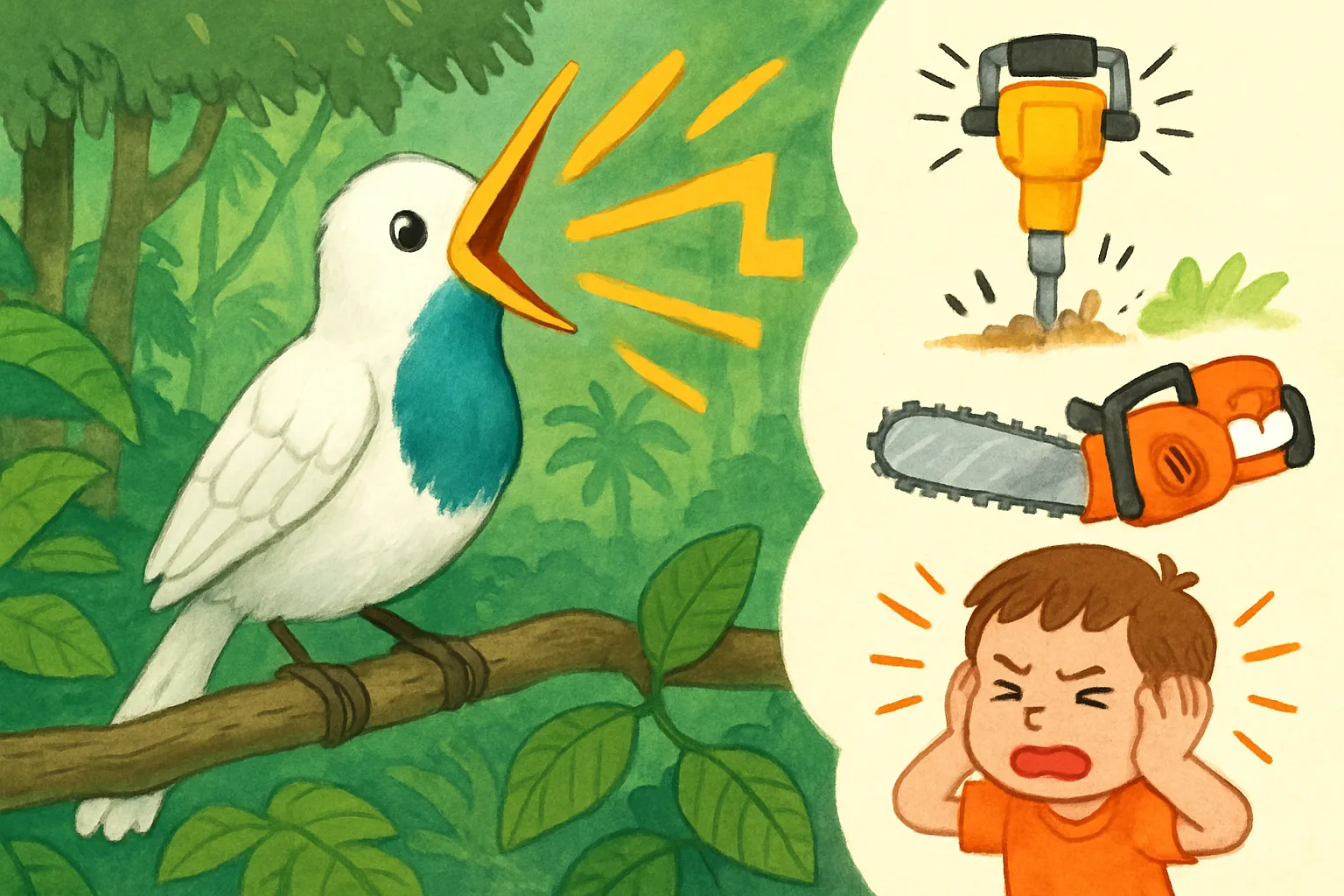
Turn It Down! Scientists Just Found the World’s Loudest Birds — and They’re as Noisy as a Jackhammer
Quick Summary
Researchers just published a huge study on bird voices. They measured more than 120 species and found two birds that are astonishingly loud. Both can hit sound levels above 120 decibels — louder than a jackhammer drilling concrete.
What Happened?
Scientists at the University of Massachusetts Amherst spent years recording and measuring bird calls. They studied 123 species in total. Their goal was to find out: which birds are the loudest, and why?
The winners are two South American birds. The bare-throated bellbird and the red-legged seriema both produce calls louder than 120 decibels. To understand just how loud that is, think of it this way: a normal conversation is about 60 decibels. A vacuum cleaner is about 75. A rock concert is around 105 to 110. And a jackhammer hammering concrete hits about 100 to 110 decibels.
These birds blow all of that away.
The bare-throated bellbird is a snow-white bird with a stout body and a striking blue-green patch on its throat and face. It lives in the forests of South America. The male bellbird uses its super-loud call to attract a mate. He blasts the call at females from his perch in the treetops.
The red-legged seriema is a tall, long-legged bird that looks a little like a roadrunner. It lives in the grasslands and open woodlands of South America. Its call is just as earsplitting.
The researchers also found something surprising. Bird calls vary enormously — from hummingbirds, which call at around 64 decibels, all the way up to these bellbirds. That is a difference of nearly 60 decibels from the quietest to the loudest. In the world of sound, that gap is enormous.
What the researchers still do not fully know is why some birds evolved to be so incredibly loud. They looked at mating habits, forest density, and flying ability, but could not find one single answer that explained it all. The mystery continues!
Why Does It Matter?
Understanding how animals communicate helps scientists protect them. Loud calls can carry for great distances through dense forest. Learning more about bird sounds helps researchers track endangered species, understand their habitats, and listen for them in places that are hard to reach. Every species has its own vocal fingerprint.
Big Words
- Decibel — the unit scientists use to measure how loud a sound is; the higher the number, the louder the sound
- Species — a group of living things that share the same characteristics and can have babies together
- Mating call — a special sound an animal makes to attract a partner
- Evolve — to change slowly over many generations to become better suited to the environment
- Radiant — just kidding — Amplitude — the strength or power of a sound wave, which determines how loud it is
Fun Fact
A hummingbird’s call, at around 64 decibels, is roughly as loud as a normal conversation. The bare-throated bellbird is nearly twice as loud on the decibel scale — but because decibels work on a logarithmic scale, it is actually about 1,000 times more powerful in energy!
Think About It
If you were a scientist studying animal sounds in a rainforest, what tools would you bring, and what other loud animals would you want to compare to the bellbird?
Sources
- Science News — The world’s loudest bird could drown out a rock concert
- CNN — Scientists identify two of the world’s noisiest birds
- Washington Post — These birds can match the earsplitting decibels of a chainsaw
- Phys.org — Biologists may have discovered two of the world’s loudest birds